WordPress is dead? Please.
If we had a dollar for every time someone declared that, we’d be sipping cocktails on a beach instead of building websites.
Yet here we are in 2025, and WordPress is still alive, well, and running a massive chunk of the internet. If you landed here searching “is WordPress dead 2025?” — here’s the real talk: No, it’s not. But let’s dig deeper and unpack what’s going on.
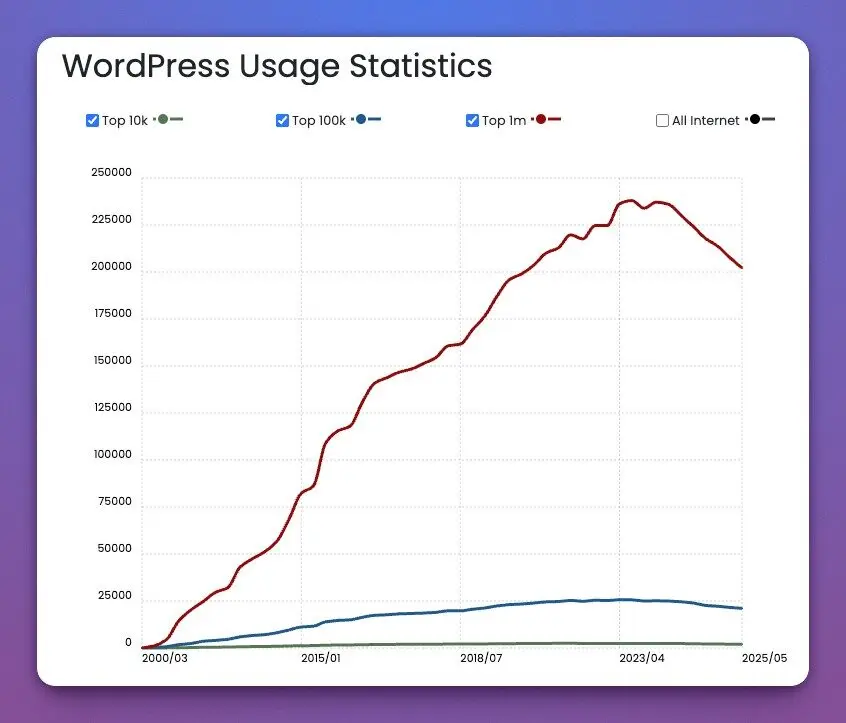
Despite the declining usage, WordPress remains a force to reckon with. BuiltWith WordPress
WordPress Is a Tool — And Tools Age
Let’s get this out of the way: WordPress is a tool. Just like Photoshop, a cordless drill, or that air fryer you swear by. And like any tool, if it doesn’t evolve, it’ll get replaced. WordPress has been around for over 20 years (that’s ancient in internet years). But instead of fading into obscurity, it’s rolled with the punches: introducing the Gutenberg block editor, enabling full-site editing, and keeping its massive plugin ecosystem thriving.
Sure, it’s got some quirks. Legacy code, janky plugins, and the occasional head-scratcher of a UI. But don’t confuse that with irrelevance. It’s constantly updated and improved by one of the largest open-source communities in the world.
So while it might not be the shiny new toy, it’s still the dependable workhorse that powers over 40% of the web (depending on source).
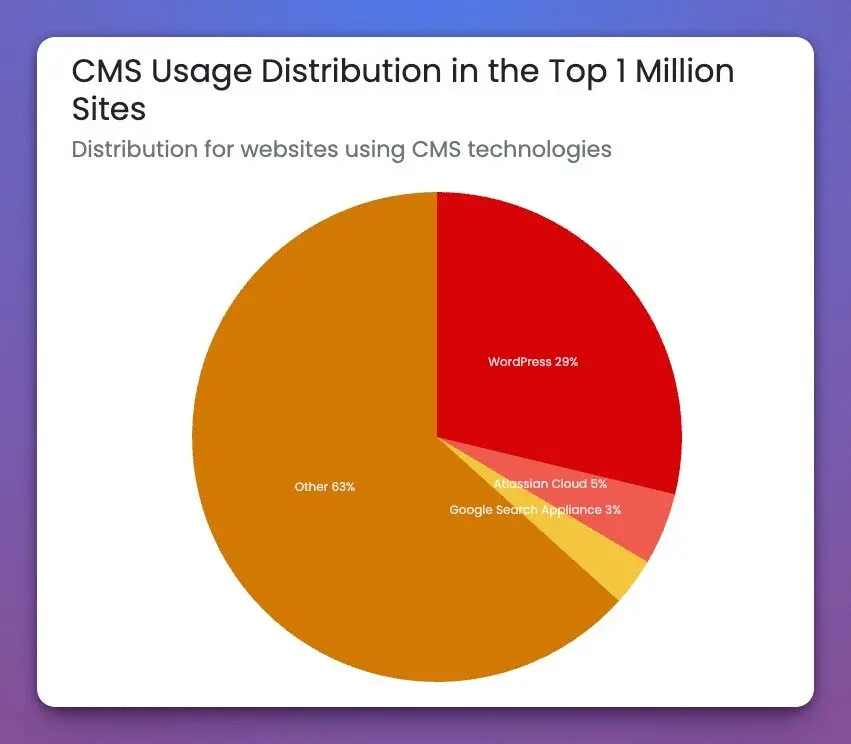
Based on BuiltWith, WordPress powers 29% of the world. However BuiltWith is only account for 30 million websites. There are over 1 billion websites in the world (Forbes, 2023)
The No-Code Movement: Clicks Over Code, Signaling WordPress Dead?
Now let’s talk about the elephant in the room: no-code tools like Webflow, Wix, Squarespace, and even Framer. These platforms promise you can build a beautiful, functional website without writing a single line of code. And honestly? That’s amazing. The no-code movement has empowered thousands of people to create online without needing to learn HTML, CSS, or how to fix a broken PHP loop.
But here’s the catch: those tools are great — until they’re not. They’re perfect for quick launches, portfolios, and MVPs. But when you need to scale? Add custom functionality? Own your content and your hosting? That’s where the limitations start showing.
No-code platforms often keep you inside their ecosystem. Want to move your site to another host? Good luck. Want to build something super custom? You’ll either hit a wall or pay through the nose. WordPress, on the other hand, is open-source, self-hosted, and as flexible as your budget and creativity allow.
Here’s a quick breakdown:
| Feature | No-Code Builders | WordPress |
|---|---|---|
| Ease of Use | Super beginner-friendly | Steeper learning curve |
| Flexibility | Limited customization | Nearly unlimited |
| Ownership | Tied to platform | You own everything |
| Community & Support | Growing | Massive ecosystem |
| Scalability | Can hit ceilings | Built for growth |
WordPress gives you the best of both worlds: you can go full no-code with page builders like Elementor, Bricks, or Breakdance — or dive deep into code when you need something tailored.
So, Is WordPress Dead? Let’s Look at the Facts
Okay, time to shut down the hype and talk data:
- WordPress powers over 43% of the entire web in 2024. That’s billions of websites.
- 63% of all CMS-based websites run on WordPress.
- Plugins galore. Need SEO? E-commerce? Memberships? There’s a plugin (or ten) for that.
- Massive developer ecosystem. Freelancers, agencies, and creators all over the world build on WordPress. It’s not going anywhere anytime soon.
- Search interest is steady. Google Trends shows that while other platforms have gained attention, WordPress still leads the pack in search volume.
- Big names use it. Think Disney, Sony, TechCrunch. Hardly a sign of a dying platform.
WordPress isn’t Perfect.
Let’s be real — WordPress isn’t perfect. It’s more complex than no-code tools. It requires regular updates. And if you’re not careful with plugins, things can break. But guess what? That’s true for any robust system.
The Real Questions: What Are You Doing With It?
Instead of asking “Is WordPress dead?”, maybe ask:
- Does my website reflect my brand?
- Is my website getting traffic?
- Am I converting visitors into leads or customers?
Because here’s the deal: the platform isn’t the point — your strategy is.
You could build the slickest site on Webflow, WordPress, or write it all in React, but if no one sees it or gets why you’re valuable, what’s the point?
Are you getting traffic to your website? What are you saying to your visitors?
What truly matters is:
- Brand Positioning: How the market sees you. Are you just another company, or are you the obvious choice?
- Traffic Strategy: How are people finding your site? SEO, ads, social, email — it doesn’t happen by magic.
WordPress just happens to be a powerful, flexible platform that supports both when used correctly.
Final Verdict: WordPress Isn’t Dead — Lazy Marketing Is
If you’re sitting there thinking, “But I heard someone say WordPress is outdated,” take a breath. They’re probably parroting some Twitter hot take or trying to sell you their shiny new platform.
WordPress is alive. Still growing. Still dominating. Still evolving.
The better question is: what are YOU doing with your website?
Need help figuring that out? Want to know what it costs to build a fast, modern, lead-generating WordPress site? Or maybe you just want someone else to handle all the plugin updates and backups?
👉 Ask us about the cost to build and maintain your WordPress website. Let’s make sure your brand isn’t the one that’s dead in 2025.
P.S. If you liked this post and want more real talk on digital strategy, web design, and growth — stick around. We’ve got more insights coming your way.